Sacred Asphalt: The Unwritten Rules of the Bunnings Car Park That Every Australian Just Knows

Photo: Rob Russell, CC BY 2.0, via Wikimedia Commons
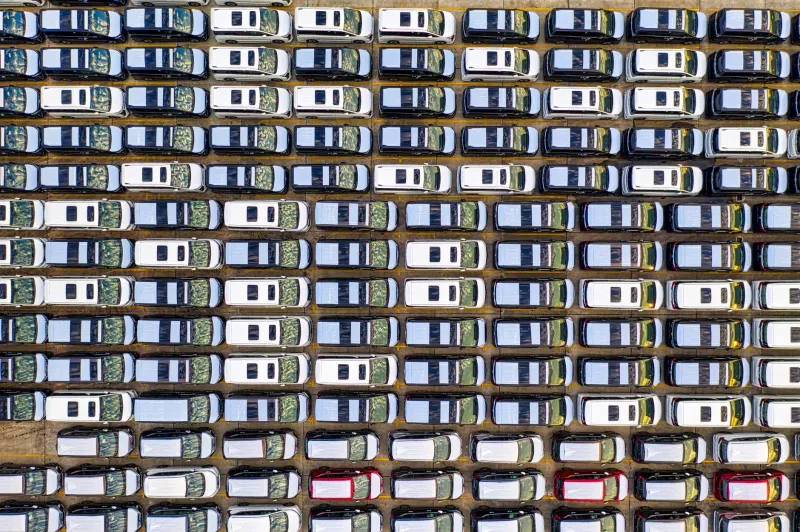
There are no signs explaining the rules. No orientation session. No laminated handout slipped under your windscreen wiper as you arrive. And yet, somehow, every Australian adult who has ever navigated a Bunnings car park on a Saturday morning operates according to the same invisible code — a complex, unspoken system of rights, obligations, and deeply held moral positions that would make a constitutional lawyer weep with admiration.
We have spent considerable time — more than is probably healthy — observing this phenomenon. What follows is the most complete written record of the Bunnings Car Park Code that has ever been attempted. It will not be the last word on the matter. There is no last word. The Code is living. The Code evolves. The Code watches you indicate without checking your blind spot and it does not forget.
The Hierarchy of Claim
Before anything else, you need to understand that the Bunnings car park operates on a strict, if invisible, hierarchy of claim. Not all parking spot entitlements are created equal.
At the top sits the Indicator Declaration — the moment you've put your blinker on for a spot, you have staked a claim recognised by all reasonable parties. This claim is inviolable. Someone pulling in from the other direction to steal a spot you've been indicating for is not merely rude; it is, in the unwritten law of the car park, a genuine act of aggression, and the social consequences — the slow headshake, the lingering eye contact, the audible exhale — are considered proportionate.
Below that sits the Visible Wait, in which you have positioned your car in obvious anticipation of a spot without yet indicating. This is a weaker claim, subject to challenge, and experienced Bunnings navigators know that the transition from Visible Wait to Indicator Declaration must be executed decisively or the window closes.
At the bottom: the Optimistic Hover, where you're just sort of... near a spot, hoping. The Hover grants you nothing legally. Morally, it generates sympathy but not protection. You are on your own.
The Reverse-Out Negotiation
Few interactions in Australian suburban life are as ritually complex as the moment when a driver in a parked car begins to reverse out while another driver waits for the spot. What unfolds is essentially a diplomatic exchange conducted entirely through headlights, hand gestures, and the precise timing of engine revs.
The waiting driver must perform a careful balance: close enough to signal genuine intent, far enough to give the reversing car actual room to manoeuvre. Too close and you're a bully. Too far and someone else might interpret the gap as an available lane and swoop in, which collapses the entire arrangement.
The reversing driver, meanwhile, is obligated to move with reasonable efficiency. A Bunnings car park is not the place for a twelve-point turn. You check your mirrors, you commit, you go. Dithering — particularly the kind that involves pulling forward again, adjusting, then reversing a second time — is tolerated once. Twice is noted. Three times and the waiting driver is fully entitled to the quiet despair visible on their face.
Both parties, upon successful completion of the exchange, are expected to acknowledge each other with a wave. The wave is not optional. The wave is the handshake that closes the deal. Failure to wave is the car park equivalent of not saying thank you to the bus driver, and it haunts people.
Trolley Governance
The trolley is both tool and territory marker in the Bunnings car park ecosystem. How you handle it upon return says more about your character than any LinkedIn profile ever could.
The Code is unambiguous: trolleys go in the trolley bay. Not beside the trolley bay. Not within what you've judged to be the "general vicinity" of the trolley bay. In it, nested properly, not at a 40-degree angle that blocks the next four from going in.
The exception — and it is a narrow exception, granted only under specific circumstances — is when the trolley bay is genuinely, measurably far away and you have a small child, a large purchase, or a legitimate physical reason. In these cases, you are permitted to leave the trolley at the end of the nearest bay, perpendicular to traffic flow, with the brake applied. You must still feel slightly bad about it. That is part of the deal.
Anyone who returns a trolley that someone else has abandoned in the middle of a parking space earns a form of quiet moral credit that doesn't expire. This is understood by everyone.
The Pedestrian Compact
Pedestrians in the Bunnings car park exist in a state of theoretical priority and practical vulnerability. The Code acknowledges both realities.
Drivers are expected to yield. Not technically, not legally — actually yield, slow down, make eye contact, wave the person across. This is non-negotiable.
In exchange, pedestrians are expected to move with purpose. The Bunnings car park pedestrian who ambles at a leisurely pace while a ute idles behind them is in technical violation of the compact. You have the right of way. You do not have the right to use it slowly. Acknowledge the waiting car, speed up marginally, give a small wave of thanks. This is the agreement. It works when everyone honours it.
The absolute nadir of car park pedestrian behaviour — the one that unites all factions, all demographics, all political persuasions — is the person who walks down the middle of the driving lane, back to traffic, earbuds in, apparently unaware that they are in a car park and not a park. There is no rule against this. There doesn't need to be. The universe handles it.
Why Any of This Matters
You could argue — and some people do, at barbecues, after a few — that none of this is serious. That it's just a car park. That people are overthinking a patch of asphalt outside a hardware store.
Those people are wrong, and somewhere in their chest they know it.
The Bunnings car park is one of the last great public spaces where Australians negotiate with strangers in real time, without apps, without referees, without anything except shared expectation and the vague threat of social embarrassment. It is democracy in action, if democracy involved a lot of reversing and the occasional disagreement about trolley placement.
The Code works because people follow it — not because they have to, but because they understand, instinctively, that it makes the whole thing function. That without it, the Bunnings car park on a Saturday morning would descend into a kind of low-stakes anarchy that nobody actually wants.
So next time you're in there, blinker on, waiting patiently, ready to wave — know that you're participating in something genuinely Australian. Daggy, maybe. Mundane, definitely. But ours.
Don't forget to wave.