Eight Bucks, Wet Thongs and a Bloke Just Standing There: The Great Servo Car Wash Con
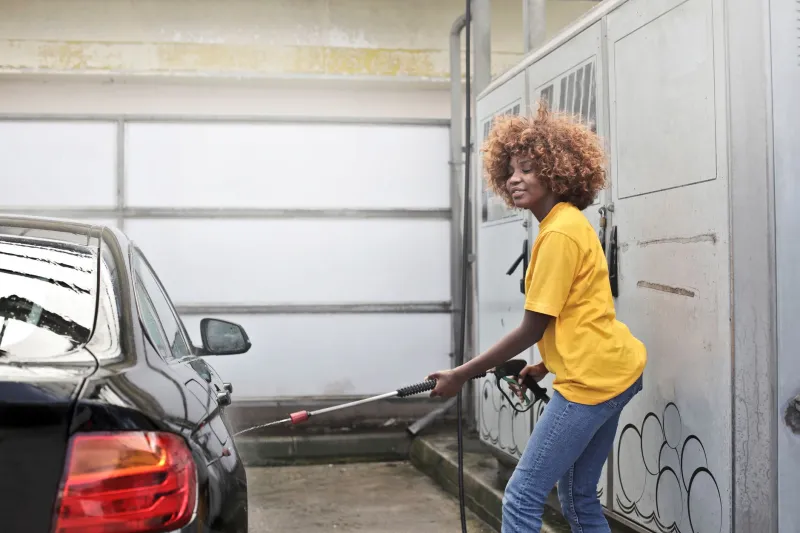
There is a moment — a specific, crystalline moment — that every Australian has experienced at least once. You're standing in a concrete bay at the servo, shoes completely saturated, holding a pressure wand that's vibrating like it's personally offended by your grip. Soapy water is running down your forearm. You've got about forty-five seconds left on the timer. Your car looks, if anything, slightly worse than when you pulled in. And somewhere nearby, a bloke in a high-vis vest is watching you from a distance, not offering to help, not leaving either. Just... observing.
Welcome to the DIY servo car wash. Australia's most elaborate and least effective exercise in self-delusion.
The Eight Dollar Lie We Tell Ourselves
Let's establish the premise clearly: you are paying money to do physical labour on your own vehicle, in public, under time pressure, with equipment you've never been trained to operate. You will get wet. You will miss entire panels. The bloke watching you will not intervene regardless of what happens.
And yet. AND YET. We pull in every time like it's a perfectly rational decision.
The psychology here is genuinely fascinating, in a broken-brained sort of way. The servo car wash works because it exists in a sweet spot between "doing something" and "doing enough." It's cheaper than a proper hand wash. It's faster than doing it at home. It requires just enough effort that you feel like you've earned the result, even when the result is a car that's technically cleaner in three specific spots and wetter everywhere else.
Eight dollars. That's the going rate for this experience at most servos. Eight dollars to stand in a concrete bay, cold water running into your sock, wondering if you should've just driven through the auto wash instead.
The Pressure Gauge Nobody Understands
Every DIY car wash bay features a control panel with at least four settings: Pre-Soak, Soap, Rinse, and one other option that nobody has ever successfully identified. There's usually a dial, or a series of buttons, or a lever that looks like it was salvaged from a 1987 tractor. The labels are either faded, peeling, or written in a font that suggests the manufacturer expected you to already know what you were doing.
You will spend roughly fifteen percent of your paid time trying to switch between settings. Another ten percent will be dedicated to figuring out why the wand has stopped working, before realising you've been holding the trigger wrong the entire time. The remaining seventy-five percent will be a frantic, increasingly desperate attempt to hose down a whole car in less time than it takes to make a cup of tea.
The pressure gauge on the wall — the one that presumably tells you something meaningful about the water pressure — has never, in the history of Australian servo car washes, been consulted by a single customer. It sits there, needle trembling, full of information that will go forever unread.
The Timer Is Not Your Friend
The countdown timer is the servo car wash's cruelest innovation. It starts the moment you insert your coins, which means the clock is running while you're still fumbling with the wand attachment, while you're trying to remember if you wound up the windows, while you're jogging back to move the car two feet forward because you parked slightly wrong.
By the time you've actually got water coming out in a direction you intended, you've already burned through a dollar fifty. The timer doesn't care. The timer has never cared. The timer exists solely to create a low-grade panic that ensures you spend the entire wash in a state of mild crisis, spraying things in the wrong order and forgetting to do the roof entirely.
And then, inevitably, the timer hits zero. The water stops. You are standing behind the car, wand in hand, staring at a back bumper that still has a dead bug on it from the drive up to Bathurst in 2022. You consider putting more coins in. You absolutely will put more coins in. This is not a question.
The Bloke Who Just Watches
Every servo car wash has one. He might be an employee. He might be waiting for his mate. He might be a philosopher who has chosen this particular concrete bay as his place of quiet contemplation. You will never know, because he will never speak to you, and you will never speak to him.
His presence is simultaneously comforting and deeply unsettling. Comforting because it suggests that someone, somewhere, is nominally in charge of this operation. Unsettling because no matter what goes wrong — wand malfunction, coin jam, full-body soaking incident — he will not move. He will simply watch, expression neutral, as you work through your problems independently.
This is, in a very real sense, the most Australian customer service experience imaginable. The vague implication that help is available, combined with the complete absence of any actual assistance. You're on your own, mate. Always were.
Why We Keep Coming Back
Here's the thing though. Despite everything — the wet thongs, the mystery settings, the tyrannical timer, the silent observer — Australians return to the DIY servo car wash with remarkable loyalty. Not because it works particularly well. Not because it represents good value. But because there's something deeply satisfying about the attempt.
We are, as a nation, extremely comfortable with the idea of a solution that is imperfect but technically functional. The servo car wash cleans the car enough. It costs less than the alternative. It gets you out of the house for twenty minutes and gives you a minor physical challenge to overcome. In a country that invented the Hills Hoist and considers a sausage in bread a complete meal, this tracks perfectly.
There's also the quiet pride of having done it yourself. Yes, a professional detailer would do a better job. Yes, your car still has water spots. Yes, you are now wearing one wet sock for the rest of the day. But you did something. You took action. You pointed a high-pressure hose at a problem and you hosed it.
That, fundamentally, is the servo car wash experience. Eight dollars, wet thongs, a bloke watching from a distance, and the unshakeable conviction that this time — this time — you'll get the roof.
You won't get the roof.
You never get the roof.