Aisle Amnesia and Trolley Guilt: The Secret Emotional Marriage Between Australians and Their Supermarket
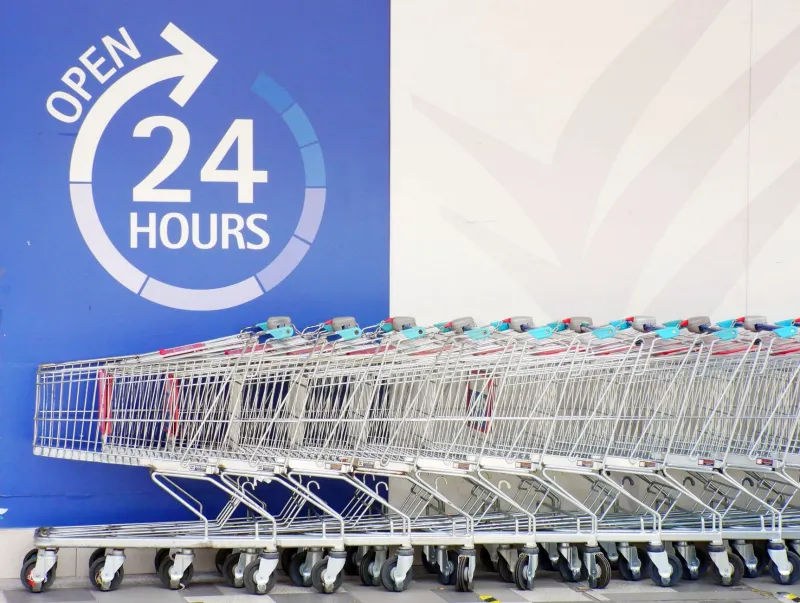
Ask any Australian which supermarket they prefer and they'll shrug, say something like "oh, wherever's convenient, really" and then subtly steer the conversation elsewhere. They are lying. They are lying to your face, in broad daylight, with a straight expression and absolutely no remorse.
Because the truth — the deeply embarrassing, entirely avoidable truth — is that most Australians have a supermarket. A real one. The one they'd go to if they had the time and the petrol. The one they mentally compare every other shopping experience against. The one whose self-checkout voice they've come to accept as a kind of ambient life companion.
We don't talk about this. We should probably talk about this.
The Woolies Person and the Coles Person Are Different Creatures
There's a taxonomy here and it matters. Woolies people tend to describe themselves as "pretty organised" and own at least one reusable bag they actually remember to bring in. Coles people are more likely to have a loyalty card they've never once checked the points on and a vague belief that the homebrand stuff is "basically the same, honestly."
Neither of these things is objectively true. Both of them feel deeply, personally true to the people involved.
The Woolies faithful will point to the layout — familiar, logical, right — as evidence that their choice is grounded in reason rather than sentiment. The Coles contingent will counter with the bakery smell, or the specials catalogue, or the time the checkout operator remembered their name once in 2019. These are not arguments. These are love languages.
IGA loyalists are a third category entirely and they are operating on a spiritual plane the rest of us haven't reached yet. We respect them from a distance.
The Shameful Detour
Here's where it gets properly messy. You're a Woolies person. You know you're a Woolies person. But it's a Tuesday night, you're running low on milk and pasta, and the Coles is literally right there — forty metres from where you're parked, open until midnight, mocking you with its convenience.
So you go in.
And it's fine, obviously. The milk is milk. The pasta aisle is slightly different but you find it eventually. You pay, you leave, you get home. Nothing bad happens.
But you don't tell anyone. You just quietly unpack the bags and if your partner notices the Coles logo on the docket you say something vague about "they were out of the good yoghurt" and change the subject. This is the supermarket equivalent of a work trip that got a bit weird. Nobody needs details.
The Loyalty Programme as Emotional Hostage Situation
A significant portion of this whole arrangement is underwritten by the points schemes, and if you think that's a coincidence you are delightfully naive. The Everyday Rewards card and the Flybuys card are not discount programmes. They are ankle monitors.
You've been accumulating points since roughly 2011. You have no idea how many you have. You have never, not once, redeemed them for anything meaningful. But the idea of abandoning those points — of starting fresh somewhere else, points-less, adrift — feels genuinely catastrophic in a way that is completely out of proportion to what those points are actually worth.
This is by design. You know it's by design. You scan the card anyway.
The Mental Gymnastics Are Olympic-Level
Ask a committed Woolies person to justify their loyalty and they will construct an argument of breathtaking complexity. The produce is fresher. The car park flows better. The self-checkout machines are faster. The homebrand range has improved significantly in the last eighteen months. They once got a really good deal on a ham.
None of this is based on rigorous comparison. All of it is delivered with the confidence of someone who has done rigorous comparison. It's magnificent, really — the way ordinary Australians will defend their supermarket choice with the same energy usually reserved for footy teams and ute brands.
Because at some level, it is the same thing. It's tribalism dressed up as pragmatism. It's identity wearing a tote bag.
The Switching Event
Occasionally — rarely, but occasionally — something happens that causes a full supermarket switch. The car park gets worse. A checkout operator is rude three times in a row. They discontinue a specific product that felt personally important. A new store opens closer to home.
And the switcher goes through something suspiciously like a breakup. There's a period of justification ("I just needed a change"), followed by overcompensating enthusiasm for the new place ("honestly their deli section is incredible"), followed eventually by a kind of settled acceptance that you are now, apparently, a different kind of person now.
Old loyalties don't vanish entirely, though. There's always a faint residue. You'll walk past the old store and feel something. Not regret exactly. More like the memory of a simpler time, when you knew exactly where the rice was and the self-checkout said your name at the end.
Look, We're All a Bit Daggy About This
The honest version of this story is that supermarkets are functionally quite similar, the price differences are marginal on most things, and the whole loyalty dynamic is a masterpiece of corporate psychology that we've all cheerfully walked into.
But knowing that doesn't really change anything, does it? You'll still feel a low-level irritation when someone mentions they prefer the other one. You'll still defend your car park as though its geometry reflects your personal values. You'll still scan the card every single time.
Because it's not really about the supermarket. It's about routine, and familiarity, and the small comforting rituals that make ordinary weeks feel manageable. The fact that one of those rituals involves a trolley and a self-checkout that never quite reads your card on the first tap is maybe a bit sad, but it's also very, very Australian.
Now if you'll excuse me, I need to go do the shopping. And no, I'm not telling you which one.